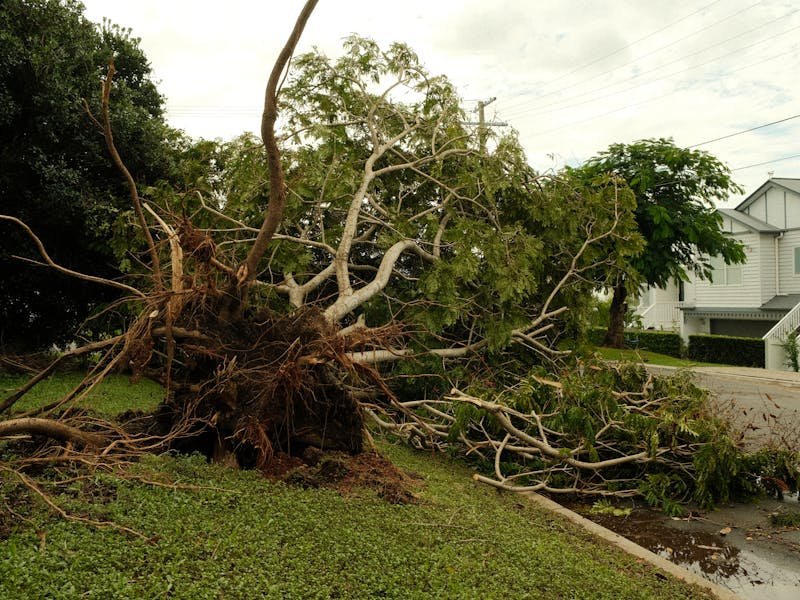
A storm rolls through Huntsville in April. One of those fast, loud ones that drops a wall of rain and shakes every window in the house. You go outside the next morning and there it is: a big limb cracked halfway off your red oak, hanging at a weird angle over the driveway. Or maybe a vertical split running up the trunk of the maple in your front yard. You look at it. You think about calling somebody. Then life happens. You have work Monday, the kids have soccer, and the tree is still standing, so it is probably fine for now.
Six months later, that crack is still there. Maybe you have stopped noticing it.
This is one of the most common situations we run into across Huntsville, Madison, and the surrounding neighborhoods. Not people who do not care about their trees. People who fully intended to deal with the problem and just never got to it. We understand that. But what most homeowners do not realize is that tree damage is not static. It does not sit there frozen in time, waiting patiently until you have a free Saturday. The moment a tree is damaged, a whole chain of biological and structural processes kicks into gear, and none of them work in your favor.
Trees do not heal the way you think they do
There is a common misconception that trees heal like people do. You break your arm, a doctor sets it, and your body rebuilds the bone stronger than before. Trees do not work that way. At all.
When a tree is wounded, whether from storm damage, a bad pruning cut, or a lawnmower hitting the trunk, it cannot regenerate the damaged tissue. What it does instead is compartmentalize. It grows new wood around and over the wound, trying to wall off the damaged area from the rest of the tree. Think of it like bricking up a room in a house instead of fixing the room itself. The damage stays. The tree just tries to build around it.
This works reasonably well for small wounds on otherwise healthy trees. A clean pruning cut on a vigorous young oak will get walled off in a season or two. But a major crack in the trunk? A large torn limb that ripped bark and sapwood on the way down? The tree cannot compartmentalize fast enough. The wound stays open, exposed to everything in the environment that wants to get inside. And in Huntsville's warm, humid climate, that list is long.
Structural cracks grow. They do not shrink.
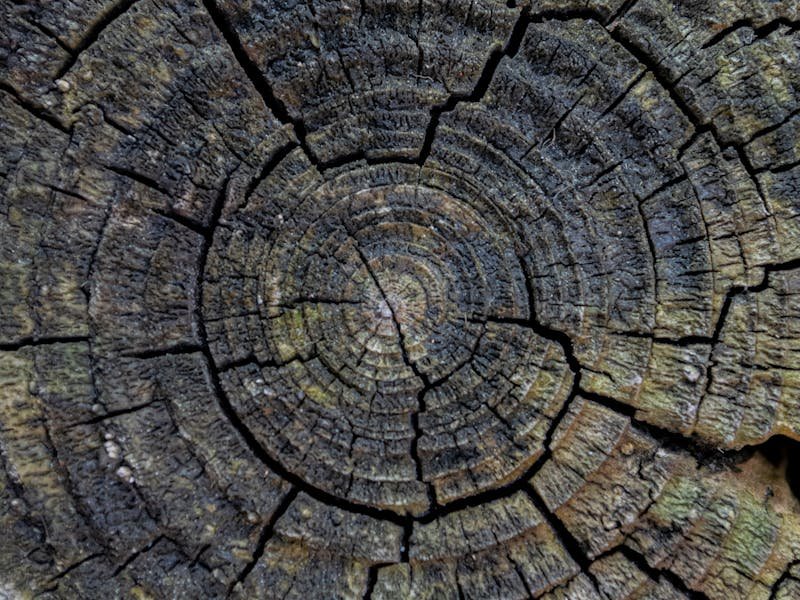
A crack in a tree trunk is a structural failure. That sounds dramatic, but it is accurate. The wood fibers that held the trunk together in that spot have separated. And once they separate, the forces that caused the crack in the first place do not go away. Wind still pushes on the canopy. The weight of the branches still pulls on the trunk. Rain still collects in the crack and freezes on cold January nights, expanding and wedging the crack wider.
We have looked at trees in neighborhoods around South Huntsville and Jones Valley where a homeowner pointed to a trunk crack and said it was not there two years ago. Then they showed us a photo from last spring and the crack was half the size it is now. That is the pattern. Cracks grow. Every storm, every freeze-thaw cycle, every strong gust of wind works the crack a little wider. The structural wood that is supposed to hold the tree together loses a little more of its load-bearing capacity each time.
At some point, and there is no way to predict exactly when, the remaining wood cannot support the load. The tree splits. It does not always happen during a storm. Sometimes it happens on a calm afternoon when the weight distribution shifts just enough. We have removed split trees from rooftops on blue-sky days.
Dead branches become projectiles
When a limb dies, whether from storm damage, disease, or getting cut off from the tree's vascular system by a spreading crack, it starts drying out. Living wood has moisture content around 40 to 60 percent. Dead wood in a standing tree drops to 15 to 20 percent within a few months. It gets lighter, more brittle, and it loses the flexibility that lets living branches bend in the wind instead of snapping.
A dead branch still attached to a tree is essentially a loaded spring. It is held in place by whatever connection remains at the branch collar, but that connection is decaying. The branch gets lighter and more brittle while the attachment point gets weaker. Eventually the attachment fails and the branch falls.
People underestimate how much damage a falling branch can do. A dead limb from a mature oak that is six inches in diameter and fifteen feet long weighs around 200 pounds. Drop that from 40 feet onto a car, a fence, a person, and the results are serious. During a storm, with wind accelerating the fall, these branches become genuine projectiles. We have seen dead branches from storm-damaged trees punch through vinyl siding, shatter skylights, and dent metal roofing. One emergency call in Weatherly Heights last spring involved a dead limb that went through a screened porch roof and embedded itself in the deck below.
Insects find damage fast
This is the part that tends to get people's attention, because it does not just affect the tree. It affects the house.
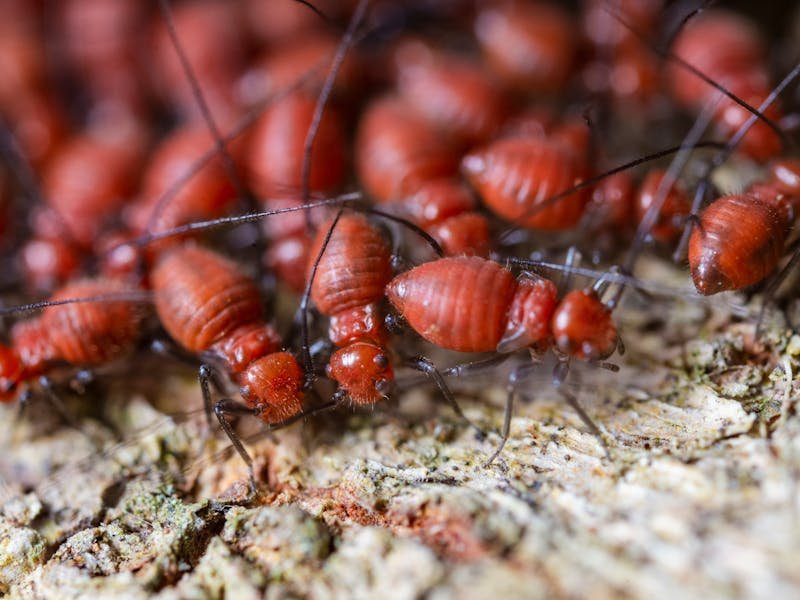
Damaged wood sends out chemical signals. Literally. When wood cells are crushed or torn, they release volatile compounds that certain insects can detect from a surprising distance. Boring beetles like the Asian ambrosia beetle, which is well established in North Alabama, can find a freshly damaged tree within days. Carpenter ants, which do not eat wood but excavate it for nesting, are also drawn to damaged and decaying trees. And then there are termites.
Subterranean termites are a constant presence in Huntsville's soil. They forage through the ground looking for dead wood, and a damaged tree with decaying tissue is an ideal target. Once a termite colony establishes a feeding site in a damaged tree in your yard, they do not stop there. They build mud tubes outward from the tree, through the soil, and toward any other wood source in range. That includes your house. Your deck. Your fence. The wood framing in your garage.
We have talked to pest control operators in Huntsville who have traced termite infestations back to a dead or damaged tree sitting thirty feet from the house. The homeowner did not connect the two things. Why would they? The tree is outside, the termites are inside. But for the colony, it was a straight line through the dirt. Removing the tree and the stump would not have prevented every termite problem, but having a large, decaying food source that close to the foundation certainly did not help.
Carpenter ants operate in a similar pattern. They nest in the damp, decaying wood of a damaged tree and then establish satellite colonies in nearby structures. If you are finding large black ants in your house and you have a damaged tree within 50 feet, the two things are probably related.
Fungal decay works from the inside out
You cannot see most of what fungi do to a tree. That is what makes them so dangerous from a structural standpoint.
When fungal spores land on an open wound, they germinate and send thread-like structures called hyphae into the wood. These hyphae secrete enzymes that break down the cellulose and lignin that give wood its strength. The process happens internally, within the heartwood and sapwood, where you cannot see it. A tree can have extensive internal decay and still look perfectly normal from the outside. Green leaves, intact bark, no obvious problems. Meanwhile, the trunk is being hollowed out inch by inch.
Alabama's humidity and warmth make this process faster than it would be in drier or colder climates. Fungal growth slows down in the winter here but does not stop. And from March through October, conditions are nearly ideal for rapid fungal colonization. A wound that might take five years to develop serious decay in Michigan can get there in two or three years in Huntsville.
The first visible sign of advanced internal decay is often mushrooms or bracket fungi appearing on the trunk or at the base. By that point, the decay has typically been active for years. The other sign is a hollow sound when you tap the trunk, or the ability to push a screwdriver into wood that should be solid. Either of those means the tree has lost a significant amount of structural wood and removal should be on the table.
Root damage hides until it is too late
Storm damage is not always above ground. High winds rock the entire tree, and the forces translate down through the trunk into the root plate. Roots can crack, shear, or partially pull free of the soil without any visible sign on the surface. The tree stays upright because enough of the root system held, but the anchorage is compromised.
Root damage from wind loading is cumulative. Each subsequent storm weakens the remaining connections a little more. The soil around stressed roots gets loosened and aerated, which lets in moisture and decay organisms. Roots that were partially torn start to rot. The tree's grip on the ground gets weaker incrementally, storm after storm, until one event finishes the job.
Trees that fail from root damage tend to go over as a whole unit. The root plate lifts out of the ground, the entire tree topples, and you end up with a crater in your yard and a full-grown tree lying across whatever was in its path. These are the failures that do the most damage to structures because the full weight of the tree comes down at once, with momentum behind it. A 50-foot water oak weighing 12,000 pounds falling from root failure is not something a roof or a car survives.
Your damaged tree is a liability problem
Alabama follows a reasonable care standard for property owners regarding trees. If a tree on your property falls on a neighbor's house, car, or fence, the question of who pays depends heavily on whether you knew or should have known the tree was a hazard.
A healthy tree that falls in a freak storm? That is generally considered an act of God. Your neighbor's insurance handles their own damage, and nobody is at fault. But a tree with a visible crack in the trunk, dead branches, or other obvious damage? If that tree falls on your neighbor's property, you could be held liable for the damage because you had knowledge of the defect and failed to act. The legal term is negligence, and it applies whether or not you actually got around to having the tree assessed.
This gets expensive fast. A tree falling on a neighbor's roof can easily cause $20,000 to $50,000 or more in damage. If the tree hits a car, add another $10,000 to $40,000. And if anyone is injured, the numbers become catastrophic. Your homeowners insurance might cover some of this, but that brings up the next problem.
Insurance claims and the "failure to maintain" problem
Most homeowners policies in Alabama cover damage from falling trees when the cause is a covered peril like wind or a storm. But insurance adjusters are not naive. They look at the tree that fell, and they look at the stump. If that stump shows years of internal decay, visible damage, or evidence that the tree was already dead before the storm knocked it over, the adjuster has grounds to reduce or deny the claim.
The specific language varies by policy, but the concept is failure to maintain. If the insurance company can demonstrate that the tree was in a state of obvious disrepair and you did nothing about it, they can argue the damage was not caused by the storm. The storm was just the final push for a tree that was going to fail regardless. And an insurer that does not want to pay a $30,000 claim has a strong incentive to make that argument.
We have seen this play out with homeowners in Huntsville who assumed they were covered and found out the hard way. One homeowner on the south side of town had a pine with a crack that had been visible for over a year. The tree came down in a storm and went through the roof of his detached garage. His insurer sent an adjuster, the adjuster photographed the old crack and the internal decay visible in the trunk, and the claim was denied. He was out the cost of the garage repair and the emergency tree removal.
The math on waiting versus acting
People put off dealing with damaged trees partly because of cost. That is understandable. Tree removal is not free. But the math almost always favors dealing with it now rather than later.
A planned removal of a medium-sized tree in Huntsville, something in the 40 to 60 foot range, typically runs $800 to $1,500. You schedule it, the crew comes out on a Tuesday morning, they take the tree down in a controlled manner, clean up, and you are done by lunch. If the tree has a damaged limb that could be addressed with pruning instead of full removal, you might be looking at $300 to $600.
Now compare that to what happens when you wait and the tree fails on its own. Emergency removal, meaning a crew has to come out after the tree has already fallen, typically costs 50 to 100 percent more. That same tree is now $1,500 to $3,000. If it fell on your house, you are adding structural repairs that start at $5,000 and go up quickly depending on the damage. A tree through a roof can easily generate $15,000 to $30,000 in repair costs. If it hit the HVAC system on the way down, add another $5,000 to $10,000. If it pulled down power lines, you are dealing with utility company response costs on top of everything else.
None of that accounts for the cost of temporary housing if your home is not livable, the deductible on your insurance (if the claim is even approved), lost time from work to deal with contractors and adjusters, or the sheer stress of the situation. A planned removal for $1,200 looks very different next to a $25,000 emergency that you saw coming.
Not every damaged tree needs to come down
This is worth saying because the assumption a lot of people make is that any damage means the tree is doomed. That is not true. Trees are tough organisms. They have been surviving storms for millions of years, and they have biological mechanisms for dealing with damage that work well under the right circumstances.
A single broken branch, even a fairly large one, is not a death sentence if the tree is otherwise healthy and the break is clean. A good pruning cut to remove the damaged wood back to the branch collar gives the tree the best chance to compartmentalize the wound. If the remaining canopy is full and the trunk is sound, that tree can live for decades more.
Minor bark damage from a glancing blow, a small crack that the tree is actively walling off with new callus growth, or a lean that has been stable and unchanged for years are all situations where monitoring and maintenance might be the right call instead of removal. Not every damaged tree is a doomed tree.
The key distinction is between damage that the tree can manage and damage that exceeds its ability to cope. A crack that is getting wider, not narrower. Decay that is spreading, not being contained. Dead wood that makes up more and more of the canopy each year. Those are the signs that the damage has crossed a line the tree cannot come back from.
What to actually do about it
If you have a damaged tree on your property and you have been putting it off, the single most useful thing you can do is get someone out there who knows what they are looking at. Not your neighbor who used to work at a nursery. Not a YouTube video. Someone who assesses damaged trees regularly and can tell you, based on the species, the type and extent of the damage, and the tree's overall condition, what is actually going on.
A qualified arborist can determine whether a crack is superficial or structural. They can check for internal decay that is not visible from the outside. They can evaluate root stability. And they can give you an honest assessment of whether the tree can be saved with pruning and monitoring, or whether it needs to come down before it makes the decision for you.
The assessment itself takes about 20 minutes for most trees. We do them for free across Huntsville, Madison, Decatur, and the surrounding areas. There is no obligation. If the tree is fine, we will tell you it is fine. If it needs some trimming to address the damage, we will explain what that involves. And if it needs to come down, we will explain why and give you a price so you can plan for it on your schedule instead of dealing with it as a 2 AM emergency in the middle of a thunderstorm.
Whatever the situation, the worst option is doing nothing and hoping for the best. Damaged trees do not get better with time. They get worse. The biology and the physics both go in one direction. Six months from now, the crack will be wider, the decay will be deeper, the insects will be more established, and the removal will be harder and more expensive.
Call us at (256) 555-0123 or fill out our contact form. We will come take a look.
Frequently asked questions
Can a damaged tree heal itself?
Trees do not heal the way animals do. They cannot regenerate damaged tissue. Instead, they compartmentalize wounds by growing new wood around the damage to wall it off. Small wounds on healthy trees can be successfully compartmentalized. But significant structural damage like trunk cracks, large broken limbs, or split crotches often exceeds the tree's ability to contain the problem. Decay organisms move in faster than the tree can wall them off, especially in Alabama's warm and humid climate.
How long can you wait to deal with a storm-damaged tree?
If the tree is leaning, has a split trunk, or has large hanging branches, it should be addressed immediately because it could fail at any time. For less severe damage like a single broken limb that has already fallen, you have more time but should not wait more than a few weeks. The exposed wound is an open invitation to insects and fungi. In Huntsville's climate, decay organisms colonize wounds quickly, and what starts as manageable damage can become a structural problem within a single growing season.
Will my homeowners insurance cover a tree that falls on my house?
Most policies cover damage from fallen trees when the cause is a covered peril like wind or a storm. However, insurers can deny claims if they determine the tree was dead, visibly damaged, or obviously neglected before the incident. If the adjuster can see evidence of pre-existing damage or long-term decay in the fallen tree, you may face a reduced or denied claim on grounds of failure to maintain your property. Dealing with a known problem before it causes damage protects both your property and your coverage.
How much more does emergency tree removal cost?
Emergency removal in Huntsville typically runs 50 to 100 percent more than planned removal of the same tree. A tree that would cost $800 to $1,500 on a scheduled basis might run $1,500 to $3,000 or more as an emergency, especially if it has fallen on a structure or is tangled in power lines. That does not include repair costs for whatever the tree damaged, which can easily run into the tens of thousands of dollars.
What should I do right now if I have a damaged tree?
Stay away from the tree, especially if it is leaning or has hanging branches. Do not attempt to cut damaged limbs yourself from a ladder. Call a tree service company to come assess the situation. A qualified arborist can tell you whether the tree can be saved with pruning and care or whether it needs to come down. Most reputable companies offer free assessments. The sooner you get someone out there, the more options you will have and the less the solution will cost.