The sound is unmistakable. If you have ever heard a large tree come down, whether it is the slow, creaking groan of a trunk giving way or the explosive crack of a major limb snapping off during a thunderstorm, it is a sound you never forget. One moment everything is normal. The next, you are looking at a 60-foot oak lying across your roof, your car, your fence, or your yard, and your brain is trying to process what just happened and what you are supposed to do next.

Living in Huntsville and the Tennessee Valley, this is not a hypothetical scenario. It is a reality that hundreds of homeowners deal with every single year. We sit squarely in the middle of Dixie Alley, the severe weather corridor that runs through the Southeast. The National Weather Service office right here in Huntsville tracks some of the most active severe weather in the country. Between tornadoes, straight-line winds, microbursts, and the garden-variety springtime thunderstorms that can still produce 50 to 70 mph gusts, our trees take an enormous beating from roughly March through June.
But storms are not the only cause of emergency tree situations. Trees fail on calm days too, especially when they have been weakened by root decay, trunk cavities, or the slow deterioration that comes with age and disease. We respond to emergency tree calls year-round, not just during storm season.
This guide is going to walk you through exactly what to do when a tree falls on or near your Huntsville property. We will cover the immediate safety steps, how to deal with your insurance company, what the emergency removal process actually looks like, what it costs, and why attempting DIY storm damage cleanup is one of the worst decisions you can make.
Step 1: Safety First — The First 10 Minutes
When a tree comes down, your first instinct might be to run outside and assess the damage. Before you do, take a breath and follow these steps in order. They could save your life or the life of a family member.
Check for Power Lines
This is the most critical step and the one that gets people killed. A downed tree that has taken out a power line or is resting on one is an immediate, life-threatening hazard. The ground around a downed power line can be energized for a radius of 35 feet or more, even if the line appears to be dead. You cannot tell by looking whether a downed line is live.
If you see any wires down, touching the tree, or if the tree hit a power pole, do the following: stay inside your house, call 911, and call Huntsville Utilities at their emergency line. Do not go outside. Do not approach the tree. Do not let anyone else approach it. Do not assume the line is dead just because the power is out in your house. Wait for the utility company to confirm the lines are de-energized before anyone goes near the tree.
This is not being overly cautious. We have responded to situations in Madison, South Huntsville, and Decatur where homeowners walked right up to trees tangled in live power lines without realizing the danger. By the grace of God, nothing happened in those cases. But electrocution from downed power lines kills people every year during storm events across the Southeast.
Assess Structural Damage to Your Home
If a tree has struck your house, you need to quickly assess whether it is safe to remain inside. Look for signs of severe structural damage: walls that have shifted, ceilings that are sagging, beams that have cracked, or any indication that the weight of the tree is actively compressing the structure. If the tree has penetrated the roof and created an opening, water damage from rain can begin immediately, so you will want to get a tarp over the opening as soon as it is safe to do so.
If there is any question about the structural integrity of your home, get everyone out and do not go back in until a professional has assessed the building. A tree lying on a roof creates unpredictable loads on the structure, and what looks stable can shift if the tree settles further or if wind changes direction.
Account for Everyone
Make sure all family members, pets, and anyone who was in or near the house when the tree fell are accounted for and safe. If anyone is trapped or injured, call 911 immediately. Do not attempt to move the tree yourself to free someone. You could make the situation worse by causing the tree to shift.
Step 2: Document Everything Before Anything Gets Moved
Once everyone is safe and any immediate dangers like power lines have been addressed, your next priority is documentation. This step is critical for your insurance claim and is something many homeowners skip in the chaos of the moment, which costs them later.
Photos and Video from Every Angle
Walk around the damage scene and take photos and video from every accessible angle. Use your phone and make sure the timestamps are on. Capture the following: the full tree including its root ball or failure point, the damage to your home or other structures, the point of impact where the tree hit, any damage to neighboring properties, the overall scene showing the tree's position relative to your house, and close-up shots of specific damage to roofing, siding, gutters, fences, vehicles, or landscaping.
If it is raining or dark, do the best you can and then take more thorough documentation in daylight. The goal is to create a complete visual record of the damage before any cleanup or removal work begins. Insurance adjusters will use these photos to validate your claim.
Write Down What Happened
While the details are fresh, write down the date and time of the incident, the weather conditions when the tree fell, what you heard or saw, and any immediate observations about what caused the failure. Did the tree snap at the trunk? Did the root ball pull out of the ground? Did it lose a major limb that then struck the house? These details can be important for your insurance claim and help the tree service company plan their removal approach.
Step 3: Call Your Insurance Company
Contact your homeowner's insurance company as soon as possible to report the damage and begin the claims process. Here is what you need to know about how insurance handles tree damage in Alabama.
What Insurance Typically Covers
Most standard homeowner's policies cover the cost of removing a tree that has damaged a covered structure, meaning your house, garage, shed, fence, or driveway. The tree removal cost is treated as part of the damage claim. If a tree falls on your house and causes $15,000 in structural damage, the cost of removing the tree (typically $1,500 to $5,000 for a large tree on a structure) is included in that claim.
Here is the part that surprises many homeowners: if a tree falls in your yard without hitting any structure, most policies provide very limited coverage for removal, often just $500 to $1,000. The reasoning from the insurance company's perspective is that a tree lying in your yard is not causing ongoing damage to a covered structure. It is inconvenient and unsightly, but it is not an insurable loss in the same way that a tree through your roof is.
How the Claims Process Works
After a major storm event in the Huntsville area, insurance adjusters are going to be slammed. Here is the typical timeline:
Day 1: You file your claim by phone or online. The insurer assigns a claim number and schedules an adjuster visit.
Days 2 to 7: An adjuster contacts you to schedule an inspection. After large storms, it can take a week or more for an adjuster to reach you due to the volume of claims. If the damage is severe and your home is uninhabitable, the insurance company should arrange temporary housing.
Days 7 to 14: The adjuster inspects the damage and prepares an estimate. They will want to see the documentation you gathered. If the tree has already been removed, they rely entirely on your photos and the tree company's records.
Days 14 to 30: The insurer approves the claim and issues payment, minus your deductible. For emergency tree removal specifically, many policies allow you to proceed with the removal before the adjuster visits, as long as you have thorough documentation. Ask your insurer specifically about this when you report the claim.
Tips for Maximizing Your Insurance Claim
Get your own removal estimates rather than relying solely on what the insurance adjuster says it should cost. Keep every receipt related to the incident, including tarps, temporary repairs, hotel stays, and tree removal. Do not sign anything from the tree removal company that releases them from liability until the job is complete and you have inspected it. And if your claim is denied or underpaid, you have the right to dispute it and request a re-evaluation.
Step 4: Call a Professional Emergency Tree Service
Now it is time to get the tree off your property. This is not the time for the cheapest quote or the first person who shows up at your door. Choosing the right company is critical, especially in an emergency situation where the stakes are high and the conditions are hazardous.
What to Look for in an Emergency Situation
Call a local company with an established presence in the Huntsville area. After storms, out-of-state storm chasers flood into town, going door to door offering quick cleanup. These operators are often uninsured, unqualified, and will be gone from the area before you discover any problems with their work. We have covered this topic extensively in our guide to choosing a tree service company, and it is even more important in an emergency situation.
Verify that the company carries general liability and workers' compensation insurance before they begin work. If a worker is injured on your property during an emergency removal and the company lacks workers' comp, you could be liable. The urgency of the situation does not change the importance of this step.
What Emergency Removal Looks Like
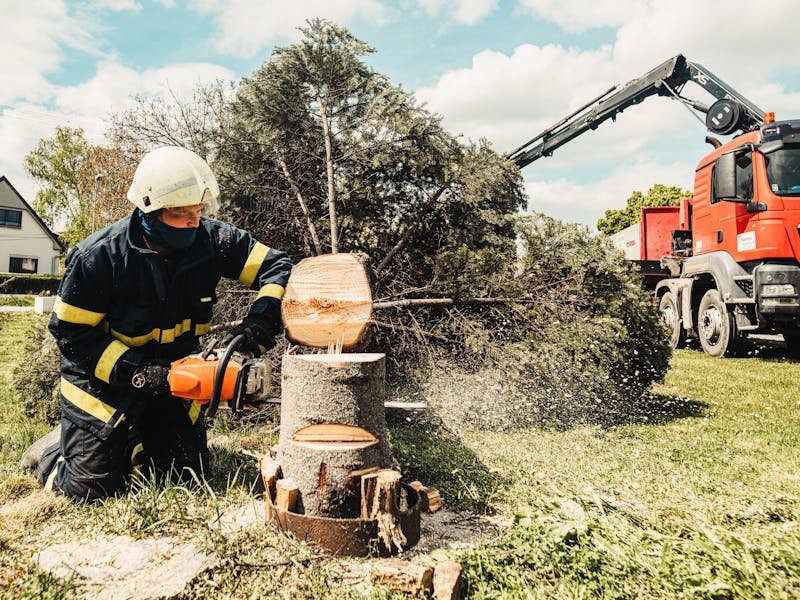
When our crew arrives at an emergency site, the first thing we do is assess the situation from a safety perspective. We look for power lines, structural instability, gas leaks, and anything else that could endanger our crew or your family. If utility lines are involved, we coordinate with Huntsville Utilities before beginning work.
The removal itself is a methodical process, not a race. For a tree on a house, the crew typically starts at the far end of the tree, cutting and removing branches section by section, working toward the trunk and the point of contact with the structure. Each section is carefully removed to avoid causing additional damage or shifting the remaining weight.
The trunk itself is usually the last piece to be addressed. Depending on its position, it may be lifted off the structure with a crane, carefully rolled away with equipment, or cut into manageable sections. Throughout the process, the crew is constantly monitoring for any signs that the tree or the structure is shifting.
For trees that have completely uprooted, the process includes removing the canopy and trunk, then dealing with the root ball. Large root balls, which are common with the shallow-rooted species like water oaks that grow in Huntsville's clay soil, can be 8 to 12 feet across and several feet deep. These require heavy equipment to extract and haul away.
Timeline for Emergency Removal
The actual removal work for a single tree typically takes 3 to 8 hours, depending on the size and complexity. A medium tree that fell in an open yard can be cleared in 3 to 4 hours. A large tree on a house with power line involvement can take a full day or more.
However, the wait time for service is the bigger variable, especially after a major storm. When a line of severe thunderstorms or a tornado moves through the Tennessee Valley, every tree service company in the area gets hit with dozens or hundreds of calls simultaneously. Response times of 24 to 72 hours are common after significant weather events. Trees on occupied homes and those blocking roads get priority. Trees that fell in open areas where they are not causing ongoing damage or safety hazards may have to wait longer.
The key is to call early, even if you are not sure whether you need emergency removal or can wait. Getting on the list early in the queue can make a significant difference in how quickly you get service.
Emergency Tree Removal Costs in Huntsville
Emergency tree removal costs more than planned removal. That is the simple reality, and it is driven by factors that are inherent to emergency work.
Why Emergency Rates Are Higher
Emergency removal commands a premium for several legitimate reasons. The crew may be responding after hours, on weekends, or in hazardous post-storm conditions. The work is more dangerous because storm-damaged trees are under unpredictable stress loads. Equipment has to be mobilized immediately rather than on a planned schedule. And the conditions, including rain, darkness, debris, and downed power lines, make everything take longer and require more caution.
A fair premium for emergency service is typically 25 to 50 percent above standard rates. Any company charging double or triple their normal rates during a storm emergency is price gouging, and you should look elsewhere.
Typical Cost Ranges for Emergency Removal
Small tree (under 30 feet) in an open area: $400 to $1,000. This covers trees that fell in yards, on fences, or on driveways without structural or utility complications.
Medium tree (30 to 60 feet) in an open area: $800 to $2,000. Larger trees generate more debris and take longer to section and remove.
Tree on a house or structure: $1,500 to $5,000+. The precision required to remove a tree from a structure without causing additional damage significantly increases the time and complexity of the job. Crane usage, if needed, adds $500 to $1,500 to the cost.
Tree involving power lines: Add $500 to $1,500+ to any of the above ranges. Utility coordination, line clearance protocols, and the additional safety measures required around energized lines all add time and cost.
Multiple trees from a widespread storm event: When a storm takes down multiple trees on a property, which happens regularly in the wooded neighborhoods of Monte Sano, Hampton Cove, and along the mountain ridges, the total cost can run $3,000 to $10,000 or more depending on the scope. However, the per-tree cost is typically lower when multiple trees are handled in a single response because the crew and equipment are already on site.
For comparison, here is what these same trees would cost under non-emergency, planned tree removal conditions: 25 to 50 percent less across the board. That price difference is one of the strongest arguments for proactive tree maintenance and storm preparation.

Why You Should Never DIY Emergency Tree Removal
Every year after major storms, we see homeowners out in their yards with chainsaws, trying to cut up downed trees themselves. We understand the impulse. You want your property back to normal. You want to save money. And you figure, how hard can it be to cut up a tree that is already on the ground?
The answer is: much harder and much more dangerous than it looks. Emergency tree work is consistently ranked among the most dangerous occupations in the country, and a large portion of the serious injuries happen to untrained individuals attempting DIY storm cleanup.
The Danger of Tension and Compression
When a tree falls, especially one that lands on a structure or across another object, the trunk and branches are under tremendous forces of tension and compression. Imagine a massive, heavy spring that has been bent and twisted and is just waiting to release. When you cut into a section that is under tension, the wood can snap, spring, or kick with explosive force. We are talking about enough force to throw a person, break bones, or send a chainsaw into your body.
Professional arborists are trained to read these forces by looking at how the tree is lying, where the weight is concentrated, and how the wood fiber is bending. They make relief cuts in a specific sequence to gradually release the tension safely. A homeowner with no training in this area is essentially guessing, and guessing wrong has catastrophic consequences.
Chainsaw Injuries Are Life-Altering
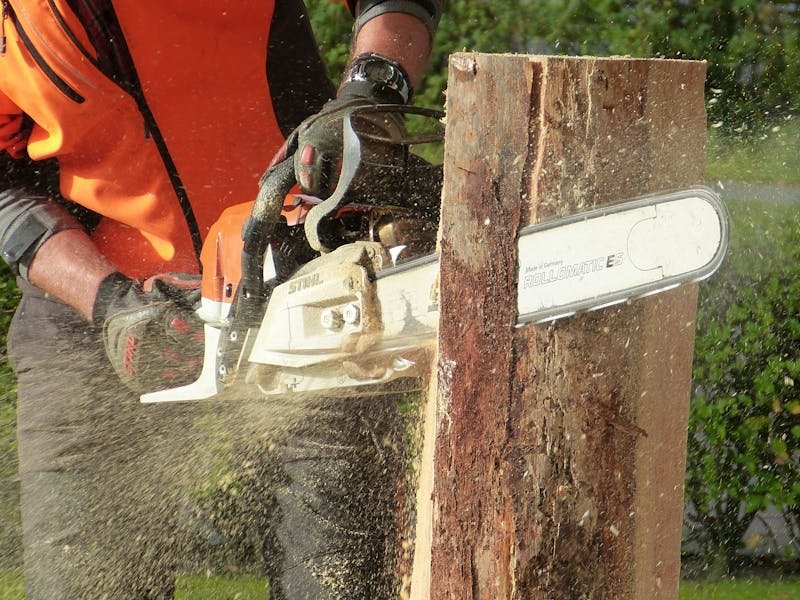
A chainsaw is one of the most dangerous power tools in existence. It has no guard, it cuts through flesh and bone as easily as wood, and it can kickback (violently reverse direction) with no warning if the tip contacts a solid object. The U.S. Consumer Product Safety Commission reports over 30,000 chainsaw-related emergency room visits per year. Many of these result in amputations, severe lacerations, and permanent disability.
Professional tree workers wear chainsaw chaps or pants with Kevlar lining, hard hats with face shields, hearing protection, and cut-resistant gloves. Most homeowners pick up a chainsaw in jeans and sneakers. We have seen the results of this, and it is not something you can undo.
Working Near Damaged Structures
When a tree is on or against a house, cutting it away requires understanding how the weight of the tree is affecting the structure and how that will change as you remove sections. Cut the wrong piece in the wrong sequence and the remaining tree could shift, driving further into the roof, sliding off the house unpredictably, or causing a section of damaged roof to collapse. This is technical work that requires experience and planning. It is not something to figure out as you go.
Hidden Power Lines
After a storm, power lines can be hidden under fallen branches, buried in leaf debris, or tangled in ways that are not immediately obvious. A homeowner cutting through branches with a chainsaw can contact a live wire that was invisible until the branch was moved. This scenario kills people every year. If there is any possibility that power lines are involved, do not approach the tree until the utility company has confirmed the lines are dead.
Huntsville's Storm History: Why Preparation Matters
The Tennessee Valley has a long and well-documented history of severe weather. Understanding this context helps explain why emergency tree removal is such a recurring need in our community and why investing in proactive tree care is so important.
Dixie Alley: The Southeast's Tornado Corridor
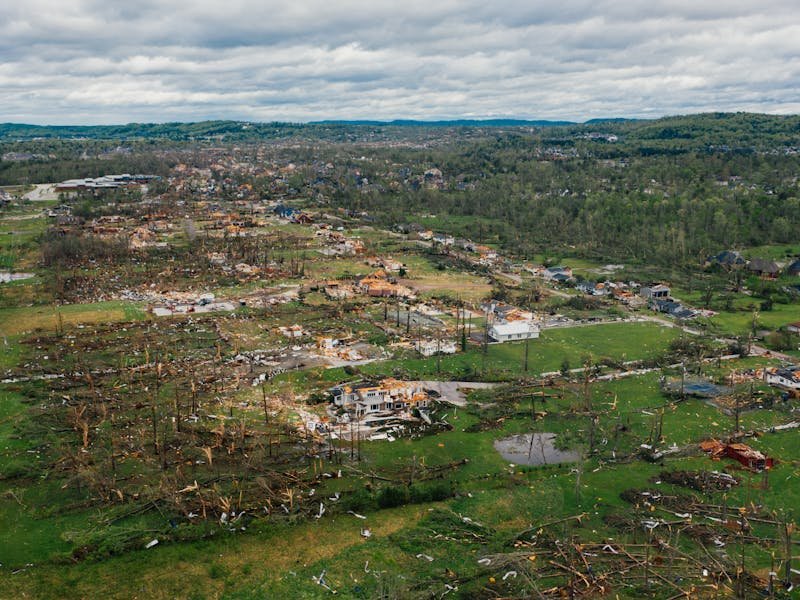
While most people associate tornadoes with the Great Plains, the Southeast has its own tornado corridor known as Dixie Alley, and Huntsville is right in the middle of it. What makes Dixie Alley particularly dangerous is the combination of severe weather frequency, the density of tree cover across the region, and the population density compared to the rural Great Plains.
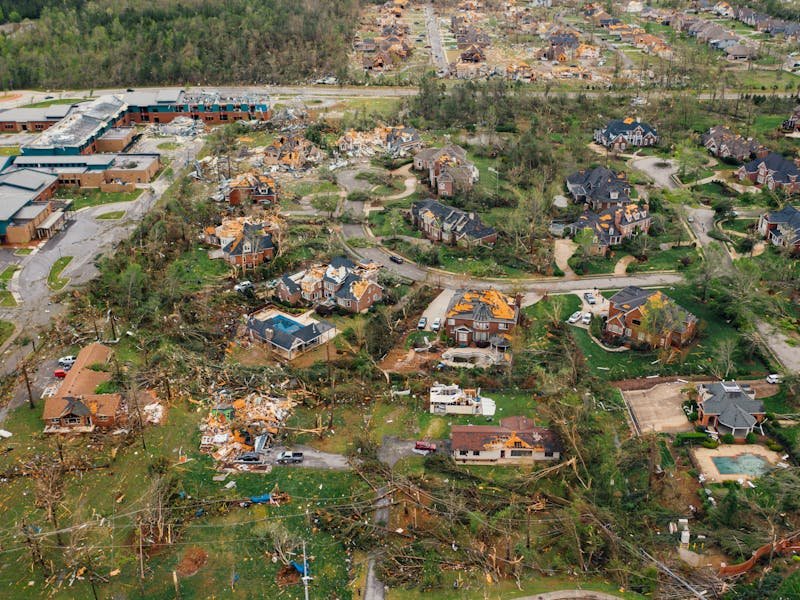
North Alabama sees severe thunderstorm and tornado activity primarily from March through June, with a secondary peak in November. The storms that roll through the Tennessee Valley regularly produce 60 to 80 mph straight-line winds that can topple weakened trees across entire neighborhoods. Tornadoes, when they occur, cause devastation that is hard to comprehend until you see it firsthand.
What This Means for Your Trees
Every tree on your property is going to face severe wind loading at some point. It is not a question of if, but when. The trees that survive severe weather are the ones that have been properly maintained: dead branches removed, canopies thinned to reduce wind resistance, structural weaknesses addressed, and root systems protected. The trees that fail are the ones that had warning signs that went unaddressed.
Proactive maintenance is always cheaper than emergency response. A tree trimming job that costs $400 to $800 is a fraction of the $2,000 to $5,000 or more you will pay for emergency removal after that same tree comes down on your house. Add in the cost of structural repairs, the disruption to your life, and the stress of dealing with insurance claims, and the financial case for prevention is overwhelming.
After the Emergency: What Comes Next
Once the tree has been removed and the immediate crisis is resolved, there are several follow-up items to address.
Structural Repairs
If the tree damaged your home, you will need a contractor to make repairs. Start with temporary repairs to prevent further damage from weather, typically tarping the roof and boarding any openings. Your insurance company may have preferred contractors, or you can choose your own. Get multiple estimates for major repairs just as you would for any significant home improvement project.
Stump Removal
The emergency removal process typically gets the tree off your property but may leave the stump behind. Stump grinding can be done as part of the emergency job or scheduled separately. If the stump is not in the way, there is no urgency to remove it immediately, and scheduling it separately may be more cost-effective. However, stumps in Alabama attract termites and other wood-boring insects, so removal within a few months is advisable, especially for stumps near your home. Our stump grinding vs. removal guide covers the options in detail.
Assess Remaining Trees
If one tree on your property failed during a storm, there is a real possibility that others were weakened. Have a professional arborist walk your property and assess the remaining trees for storm damage, including cracked trunks, split branches, root damage from soil saturation, and any lean that was not present before the storm. Addressing these issues before the next storm event prevents another emergency.
Consider Replanting
Losing a mature tree is genuinely sad, especially when it was a large shade tree that you and your family enjoyed. When you are ready, consider replanting with a species that is well-suited to your specific site conditions and that will not create the same problems as the tree you lost. If a water oak growing too close to your house was the culprit, replace it with a smaller species planted further away. Your arborist can recommend species that are well-adapted to Huntsville's climate, soil, and growing conditions while being less prone to failure.
Frequently Asked Questions
What should I do immediately when a tree falls on my house?
Your absolute first priority is safety. Check for downed power lines and do not approach the tree if any wires are involved. Call 911 if there are power lines down, gas leaks, or if anyone is trapped. Get everyone out of the house if there is any sign of structural compromise. Once everyone is safe, call your homeowner's insurance company to start the claim process. Then take thorough photos and video of all damage from safe distances. Finally, call a reputable local emergency tree service to remove the tree. Do not attempt removal yourself.
How much does emergency tree removal cost in Huntsville, AL?
Emergency tree removal in the Huntsville area runs 25 to 50 percent more than standard removal due to the urgency, hazardous conditions, and after-hours work often required. Expect $400 to $1,000 for small trees in open areas, $800 to $2,000 for medium trees, and $1,500 to $5,000 or more for large trees on structures or involving power lines. Widespread storm damage with multiple downed trees can run $3,000 to $10,000 or more per property. These costs are often covered partially or fully by homeowner's insurance when a structure has been damaged.
Does homeowner's insurance cover emergency tree removal in Alabama?
Generally, yes, when the tree has caused damage to a covered structure such as your home, garage, fence, or driveway. The tree removal cost is typically included as part of the overall damage claim. If a tree falls in your yard without hitting any structure, coverage is usually limited to $500 to $1,000 or may not be covered at all. Your deductible will apply. Always document the damage thoroughly with photos and video before any cleanup begins, and contact your insurance company before authorizing removal work to confirm what will be covered under your specific policy.
How long does emergency tree removal take?
The physical removal work takes 3 to 8 hours for most situations, with large trees on structures or involving power lines taking the longest. However, the wait time for service after a major storm event is the bigger variable. When severe weather hits the Tennessee Valley, tree service companies receive dozens or hundreds of calls simultaneously. Response times of 24 to 72 hours are typical, with trees on homes and blocking roads getting priority. Call as early as possible to get on the list, and be patient with the company. They are working as fast as safely possible.
Can I remove a fallen tree myself to save money?
For a small tree that has fallen in an open area away from structures, power lines, and other hazards, experienced chainsaw users can handle the cleanup. But for any tree on a structure, near power lines, hung up in another tree, or under significant tension from being bent or twisted, the answer is absolutely no. Storm-damaged trees are under unpredictable forces that can cause wood to snap, spring, or kick violently when cut. Professional tree workers have the training, equipment, and safety gear to manage these hazards. The cost of an emergency room visit from a chainsaw injury or a fall far exceeds the cost of professional removal.
Who is responsible for a neighbor's tree that falls on my property?
In Alabama, the general rule is that damage from a fallen tree is covered by the property owner's insurance where the damage occurred, not the tree owner's insurance. If your neighbor's tree falls on your house, your homeowner's policy is the one that responds. The exception is if the tree owner was negligent, meaning the tree was clearly dead or hazardous and they failed to act despite being aware of the danger. If you have a neighbor's tree that concerns you, document your concerns in writing and notify the neighbor in writing. Keep copies of all correspondence. In any case, call your own insurance company first to report the damage.