Whether you are planning a tree removal around your work schedule, preparing for a construction project, or just trying to understand what to expect when the crew shows up, one of the most practical questions homeowners ask is: how long is this going to take?
The honest answer is that tree removal timelines vary enormously. A small ornamental tree in an open front yard might be down, cut up, and hauled away in an hour. A massive 80-foot oak wedged between your house and your neighbor's fence could take a full day or longer. Most residential tree removals in the Huntsville area fall somewhere in between.
At Huntsville Tree Pros, we remove trees across Huntsville, Madison, Decatur, and surrounding communities every week. This guide is based on our real-world experience, not theoretical averages. We will walk you through how long tree removal takes by tree size, what factors speed things up or slow them down, what the process actually looks like on removal day, and how to plan around the work.
Tree Removal Time by Tree Size
Tree size is the most significant factor in how long removal takes. Here are realistic time estimates for typical residential tree removals, assuming a professional crew of 3 to 4 workers with standard equipment:
| Tree Size | Height Range | Typical Removal Time | Common Examples |
|---|---|---|---|
| Small | Under 30 feet | 1 – 2 hours | Crape myrtles, dogwoods, small ornamentals, young pines |
| Medium | 30 – 60 feet | 2 – 4 hours | Mid-size oaks, maples, mature Bradford pears, medium pines |
| Large | 60 – 80 feet | 4 – 6 hours | Large oaks, hickories, tulip poplars, tall pines |
| Very Large / Complex | 80+ feet or high risk | 6 – 10+ hours | Massive oaks, old-growth pecans, trees on structures |
These times include the actual cutting and felling, limb processing, trunk sectioning, and basic cleanup. They do not include stump grinding (which is typically a separate step) or extensive site restoration.
Factors That Affect How Long Tree Removal Takes
Size alone does not tell the whole story. Two trees of identical height can have drastically different removal times based on their specific circumstances. Here are the factors that matter most:
1. Location and Surroundings
This is arguably the most important factor after size. A tree standing in the middle of an open field can be felled in one piece in minutes. The same tree positioned between a house and a power line requires careful sectional dismantling from the top down, which can take hours.
Common location challenges we encounter on Huntsville properties include:
- Proximity to structures — Trees close to houses, garages, sheds, or fences cannot be felled in one piece. Each limb must be carefully rigged and lowered to prevent damage. In neighborhoods like Blossomwood, Five Points, and Twickenham, where historic homes have mature trees growing very close to structures, this careful approach is standard.
- Power line proximity — Trees near power lines require coordination with Huntsville Utilities and may need line-clearance-qualified climbers. Some situations require the utility to de-energize lines before work can begin, which adds wait time.
- Fenced backyards with limited access — If the tree is in a backyard with only a narrow gate for access, large equipment cannot reach it. Crews must carry equipment in, carry cut wood out by hand, and chip branches at the curb. This adds significant time.
- Slope and terrain — Trees on steep hillsides—common on properties near Monte Sano, Green Mountain, and Wade Mountain—are harder and slower to work on. Equipment positioning is limited, and safely controlling where cut sections fall is more challenging on a slope.
2. Tree Species and Wood Density
Different tree species have different wood densities, branch structures, and growth patterns that affect removal time:
- Dense hardwoods (oaks, hickories, pecans) cut slower, are heavier per section, and require more effort to handle. An oak trunk section the same size as a pine section can weigh two to three times as much.
- Softwoods (pines, sweetgums, tulip poplars) cut faster and are lighter to handle but can be taller, requiring more climbing and more cuts.
- Branching patterns matter. A water oak with a massive spreading canopy has far more limb volume than a straight-trunked loblolly pine of the same height. More limbs means more individual cuts, more rigging, and more time chipping or hauling.
3. Tree Condition
The health and structural integrity of the tree significantly affect how the crew approaches the job:
- Dead trees can be more dangerous and time-consuming to remove than living trees. Dead wood is unpredictable—branches can snap without warning, the trunk can fracture in unexpected ways, and the root system may be compromised, making the tree unstable even before cutting begins. Climbers must test every limb before putting weight on it.
- Storm-damaged trees that are partially broken, split, or leaning at unnatural angles present complex rigging challenges. The tree is under structural stress, and cutting in the wrong sequence can cause it to shift or fall unpredictably.
- Trees with significant lean must be carefully counterbalanced during felling or dismantled from the top down to prevent them from falling in the wrong direction.
- Healthy, structurally sound trees are actually the most straightforward and predictable to remove. The wood behaves as expected when cut, branches hold weight for climbing, and the tree responds predictably to directional felling techniques.
4. Equipment Used
The type of equipment available for the job has a dramatic impact on speed:
- Crane-assisted removal is the fastest method for large trees in accessible locations. A crane lifts cut sections directly out, eliminating the time-consuming process of rigging and lowering pieces manually. A job that might take 6 hours with climbing and rigging can sometimes be done in 2 to 3 hours with a crane.
- Bucket truck / aerial lift allows the climber to work from a stable, elevated platform instead of free-climbing. This speeds up the trimming and sectioning process considerably.
- Climbing only is necessary when vehicle access to the tree is limited. Climbing is slower than working from a bucket truck or crane, adding time to the job.
- Chipper vs. hauling — A chipper on site processes branches immediately into chips, which is faster and more efficient than loading branches whole onto a truck for disposal.
5. Crew Size
A larger crew can significantly reduce overall removal time. For a standard residential tree removal in Huntsville, most professional crews run 3 to 4 workers. For large or complex jobs, crews of 5 to 6 (or more) may be deployed. The additional ground crew members handle limb processing, chipping, loading, and raking simultaneously while the climber or crane operator works on the tree itself.
6. Weather Conditions
Huntsville's weather plays a role in scheduling and pacing tree removal work:
- Rain makes climbing dangerous and can waterlog the ground, making it difficult for heavy equipment to operate without tearing up your lawn. Most professional tree services will reschedule rather than work in significant rain.
- Extreme heat is a factor during Huntsville's summers (June through September), where temperatures frequently exceed 90 degrees Fahrenheit. Crews take mandatory hydration breaks, which adds some time to long jobs.
- Wind above about 25 mph makes climbing and crane work unsafe. High-wind days may result in postponement.
What to Expect on Tree Removal Day: A Step-by-Step Timeline
Understanding the sequence of events on removal day helps you plan your schedule and know what is happening in your yard. Here is what a typical medium-to-large tree removal looks like when our crew arrives at a Huntsville property:
Arrival and Setup (15 – 30 minutes)
The crew arrives with one or more trucks, a chipper, and whatever specialized equipment the job requires (bucket truck, crane, etc.). They assess the site, confirm the work plan, set up safety cones and caution tape around the work zone, and position equipment. If the tree is near power lines, they confirm clearance with the utility before starting.
Limb Removal (30 minutes – 3 hours)
The climber ascends the tree (or is lifted via bucket truck) and begins removing branches from the top down. Each limb is either rigged and lowered with ropes (when near structures) or dropped to the ground crew (in open areas). The ground crew immediately feeds branches into the chipper or stacks them for loading. This phase takes the longest on trees with large, spreading canopies.
Trunk Sectioning (30 minutes – 2 hours)
Once the canopy is removed, the remaining trunk is cut into manageable sections from the top down. Each section is lowered with rigging or, in open areas, allowed to fall to the ground in a controlled direction. Trunk sections from large hardwoods can weigh hundreds of pounds per piece and must be handled carefully to prevent lawn damage. The ground crew rolls sections to a staging area for loading.
Felling the Final Section (15 – 30 minutes)
The last 10 to 15 feet of trunk is typically felled in one piece using a directional felling cut. The crew clears the fall zone, cuts a notch and back cut, and uses wedges to control the direction of fall. This is one of the most skill-intensive parts of the job, and a good crew makes it look effortless.
Cleanup and Loading (30 minutes – 1 hour)
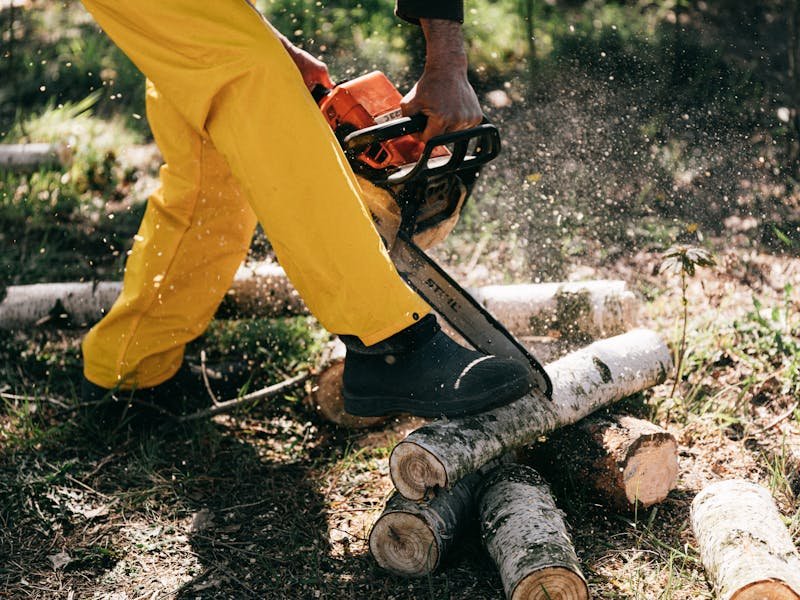
Trunk sections are loaded onto the truck for removal (or cut and stacked if the homeowner wants to keep the wood). The work area is raked, remaining debris is collected, and the lawn is cleared of wood chips, sawdust, and small branch debris. The crew inspects the area to make sure nothing has been damaged and the property is left clean.
Stump Grinding (30 minutes – 2 hours, if included)
If stump grinding is part of the job, it is typically done after the tree removal is complete. The grinder is positioned over the stump and grinds it down 6 to 8 inches below grade. The resulting hole is filled with wood chips and raked smooth. Stump grinding time depends on stump diameter and wood hardness. For more on stump grinding, see our guide on tree removal costs in Huntsville.
How Long Does It Take to Get a Tree Removal Scheduled?
Beyond the day-of timeline, homeowners often want to know how far in advance they need to plan. Here is what to expect for scheduling tree removal in the Huntsville area:
- Emergency tree removal (tree on a house, tree on power lines, dangerous leaner after a storm): same day to 24 hours. Our emergency tree service crew responds as quickly as possible to urgent situations.
- Routine tree removal during slow season (mid-summer, mid-winter): typically 1 to 2 weeks from estimate to completion.
- Routine tree removal during peak season (spring storm season March through June, fall cleanup September through November): 2 to 4 weeks is common. The busiest companies may book out further.
- Large or complex jobs requiring crane or specialized equipment: 2 to 4 weeks for scheduling, as equipment must be reserved and permits may be needed.
Do You Need a Permit for Tree Removal in Huntsville?
Permit requirements can add time to your tree removal timeline. In the City of Huntsville, the rules depend on the tree's size, location, and any applicable zoning overlays:
- Trees in a designated floodway or steep slope overlay: A land disturbance permit may be required before removal.
- Large-scale clearing (removing many trees for construction or development): A grading and clearing permit is typically required and can take several weeks to process.
- Individual trees on private residential property: In most Huntsville neighborhoods, individual tree removal on your own residential property does not require a permit, but it is always wise to check with the city's planning department, especially if you are in a historic district or HOA community.
- Dead or hazardous trees: These are almost always exempt from permit requirements since they pose a safety risk.
Your tree service company should be familiar with local requirements and can advise you on whether a permit is needed for your specific situation. For a deeper look, read our guide on Huntsville tree ordinances and permits.
Tips for Planning Around Tree Removal
Based on our experience with thousands of tree removals in the Huntsville area, here are practical tips for planning around the work:
- Clear your vehicles from the driveway and the street in front of your property. Tree crews need space for trucks, chippers, and potentially a crane. Moving your cars before the crew arrives prevents delays.
- Secure pets indoors. The noise from chainsaws and chippers is loud and can frighten animals. Dogs in particular should be kept inside and away from the work zone.
- Let your neighbors know. Tree removal is noisy and may temporarily block parts of the street. A courtesy heads-up prevents complaints and helps neighbors plan their day.
- Expect some lawn impact. Heavy equipment and falling wood will leave marks on your lawn. A good crew minimizes this, but some temporary lawn damage is unavoidable with large tree removals. The yard recovers within a few weeks during the growing season.
- Plan for the stump. Decide in advance whether you want the stump ground or left in place. Scheduling stump grinding with the tree removal saves a separate trip and usually costs less.
- Ask about wood. If you want to keep firewood or log rounds for woodworking, tell the crew before they start. Otherwise, they will load everything for disposal.
For a complete checklist on getting your property ready, see our guide: How to Prepare Your Yard for Tree Removal Day.
Ready to Schedule Tree Removal in Huntsville?
Huntsville Tree Pros provides fast, professional tree removal across the Huntsville metro area. We will give you an honest time estimate during your free consultation so you can plan your day accordingly. Most residential trees are down and cleaned up in a single visit, and we treat your property with care from setup to final cleanup.