
Look, we are a tree service company, so we have an obvious financial interest in telling you to hire professionals for everything. We get that. And if this article were just a long sales pitch disguised as helpful advice, you would be right to click away. But that is not what this is. We genuinely believe that there are things most Huntsville homeowners can and should handle themselves when it comes to their trees, and we are going to tell you exactly what those are.
We are also going to be blunt about the stuff that scares us, and we do not scare easily. We are the ones hanging from ropes 70 feet up in a tulip poplar or running a chainsaw while standing on a branch thicker than our leg. We do dangerous work every single day and we are comfortable with it because we have the training, the equipment, and the experience to manage the risk. What keeps us up at night is the thought of the homeowner in Madison or South Huntsville who watches a couple of YouTube videos, rents a chainsaw from the hardware store, and decides to take down the 40-foot pine tree leaning toward his house on a Saturday afternoon.
We have seen what happens when that goes wrong. We have been called to job sites after DIY tree work accidents, and some of those calls stay with you for a very long time. So this article is our honest attempt to draw a clear line between what is reasonable for a homeowner to tackle and what should absolutely, without exception, be left to trained professionals with proper equipment and insurance.
What You Can Safely DIY: The Green Light List

Let's start with the good news. There is a meaningful amount of tree care that a reasonably handy homeowner can handle safely and effectively. Doing these things yourself saves money and helps you stay connected with your landscape, which is honestly good for both you and your trees.
Small Branch Pruning from the Ground
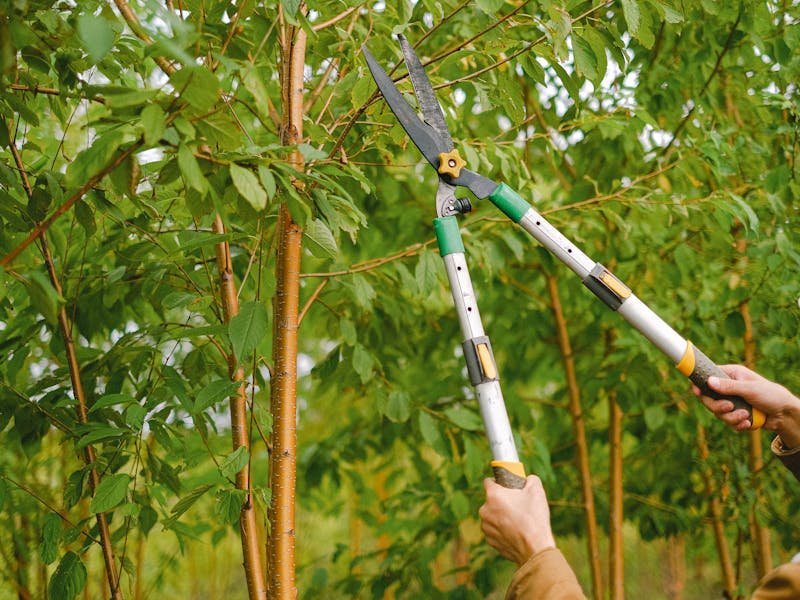
If you can reach a branch from the ground with a hand pruner, loppers, or a pole pruner, and the branch is under about 2 inches in diameter, you can prune it yourself. This covers a lot of routine maintenance: removing suckers at the base of the trunk, trimming low-hanging branches that block a walkway or driveway, cutting out dead twigs and small dead branches, and shaping young ornamental trees like crepe myrtles, dogwoods, and Japanese maples.
The key rules for safe and effective DIY pruning are straightforward. Always cut back to a branch collar or a lateral branch, never leave a stub sticking out. Do not remove more than about 25 percent of the canopy in a single year. Make clean cuts with sharp tools. And for the love of your crepe myrtles, do not top them. We see crepe murder every February across Huntsville from Weatherly Heights to Meridianville, and it hurts our souls. Just don't.
Mulching
Applying mulch around your trees is one of the best things you can do for their health, and it is a pure DIY job. Spread 3 to 4 inches of organic mulch, wood chips, shredded bark, or composted leaves, in a ring from about 6 inches away from the trunk out to the drip line or as far as practical. Do not pile mulch up against the trunk in a volcano shape. Mulch volcanoes hold moisture against the bark and promote rot. Keep it flat and keep it off the trunk.
Mulch suppresses weeds, retains soil moisture (a real benefit during Huntsville's hot, dry summers), moderates soil temperature, and improves soil biology as it decomposes. It is especially valuable for trees growing in our heavy red clay, where soil structure improvement is always welcome.
Visual Inspection
You do not need a degree in arboriculture to spot obvious problems with your trees. Walk your property a few times a year and look up. Do you see large dead branches? Mushrooms at the base? Cracks in the trunk? A lean that was not there before? Bark peeling off in big sections? These are all warning signs that something is wrong and a professional should take a closer look.
The best times to inspect are in late spring after everything has leafed out, when dead branches in the canopy are most visible, and in late fall after the leaves drop, when the branch structure is fully exposed. You do not need to climb the tree or get on a ladder. Just walk around it and look. Binoculars help for seeing detail in the upper canopy.
Watering During Drought
Huntsville can get brutally dry from late June through September, and established trees can suffer from drought stress just like your lawn. If you have not had significant rain in two to three weeks and temperatures are above 90 degrees, a deep watering of your mature trees can make a real difference, especially for species that are sensitive to drought like dogwoods, sweetgums, and maples.
Use a soaker hose or a garden hose set to a slow trickle and let it run in the root zone for an hour or two. You want the water to penetrate deeply into the soil, not just wet the surface. Do this once every couple of weeks during extended dry spells.
Cleaning Up After Storms
After a thunderstorm passes through, and they pass through the Tennessee Valley plenty, you can safely clean up fallen branches and debris on the ground. Drag them to the curb, run them through a chipper if you have one, or stack them for pickup. Just leave anything that is still hanging in the tree to the professionals. We will get to why in the next section.
What You Should Never DIY: The Red Line
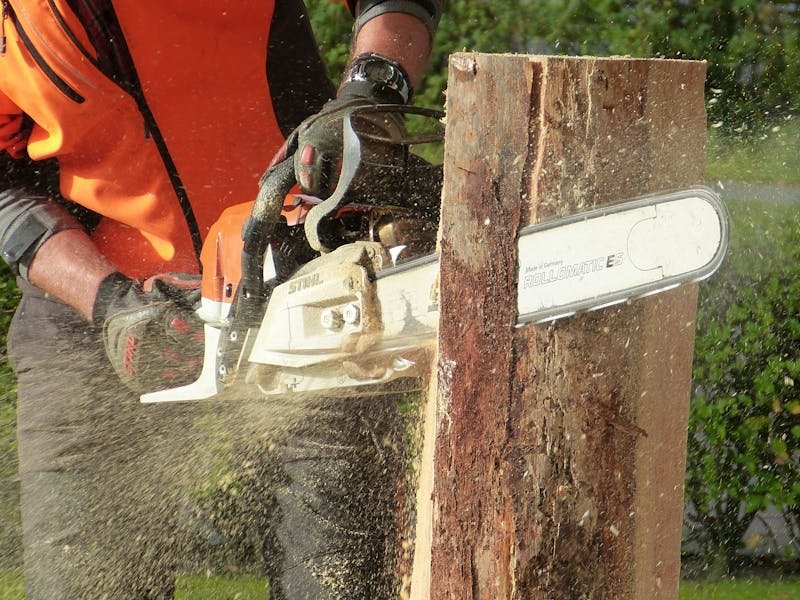
Now for the part where we stop being encouraging and start being deadly serious. The following types of tree work have no business being attempted by untrained homeowners. Not some of the time. Not if you are careful. Not if you have watched the videos and think you understand. Never. And here is why.
Anything Requiring a Ladder
This might surprise people, but ladders and tree work do not mix, not even for professionals. In the tree care industry, we use ropes, harnesses, and aerial lifts to work at height. Ladders are inherently unstable when leaned against a tree because the bark is uneven, branches shift under weight, and the base can kick out on uneven ground. A tree is not a building. It moves, it flexes, and it does not provide the stable, flat surfaces a ladder needs.
The Consumer Product Safety Commission reports that ladder-related injuries send more than 164,000 Americans to the emergency room every year. Many of those are from homeowners on ladders while doing yard work and tree pruning. A fall from just 10 feet can result in broken bones, spinal injuries, or traumatic brain injuries. A fall from 20 feet or more is often fatal.
We cannot tell you how many times we have driven through neighborhoods in Five Points, Blossomwood, or Jones Valley and seen a homeowner on an extension ladder propped against a tree with a chainsaw in hand. Every time we see it, our stomachs drop. That is one of the most dangerous positions a person can be in. If the chainsaw kicks back, if the branch moves when you cut it, if the ladder shifts even slightly, the outcome can be catastrophic.
Anything Near Power Lines
This one is non-negotiable and there are no exceptions. If any part of a tree is within 10 feet of a power line, you stay away from it. Period. Electricity can arc through the air across gaps, travel through wet branches and green wood, and kill you instantly. You do not have to touch the wire. Getting close enough is enough.
In Alabama, only utility-approved line clearance arborists are legally permitted to work within close proximity to energized power lines. Your local utility company, Huntsville Utilities or TVA depending on your location, will typically trim branches that are threatening their lines at no cost to you. If you have a tree that needs more extensive work near power lines, a professional tree service with line clearance certification can coordinate with the utility to have the lines de-energized or use specialized techniques to work safely.
We deal with trees near power lines constantly across the Huntsville metro. Loblolly pines growing into lines along the older streets in Dallas Mill and Old Town, oaks reaching across lines in the more established neighborhoods, and storm-damaged trees tangled in wires after every major weather event. Every one of those situations is a life-threatening hazard, and we approach them with extreme caution even with years of training. A homeowner with a pole saw has no business being anywhere near them.
Large Branch Removal
Any branch larger than about 4 inches in diameter or more than 10 feet off the ground should be left to professionals. Why? Because large branches are heavy, and they do not behave the way you expect when you cut them.
A green oak branch that is 8 inches in diameter and 12 feet long can easily weigh 200 to 300 pounds. When you cut it, it does not just fall straight down. It swings, it twists, it bounces, and it can kick back toward you in ways that physics makes very hard to predict. Professional arborists use rigging systems, ropes and pulleys, to control the descent of heavy branches and lower them to the ground in a controlled manner. This rigging takes training and specialized equipment that homeowners simply do not have.
We had a case a couple of years ago in Hampton Cove where a homeowner tried to remove a large dead limb from a water oak in his backyard. He made his cut, and the branch, which he estimated at about 150 pounds, swung sideways and struck him in the chest, knocking him out of the tree. He fell about 15 feet and broke his pelvis and three ribs. His wife found him in the yard and called 911. He spent a week in the hospital. The cost of the professional removal he was trying to avoid would have been about $400. His hospital bill was over $45,000.
Chainsaw Work in Trees
Using a chainsaw while on the ground to cut firewood or buck up fallen logs is one thing. Using a chainsaw while elevated in a tree is something entirely different, and it is the single most dangerous activity in the tree care industry. Even fully trained professional arborists with thousands of hours of chainsaw experience are at risk every time they make a cut in a tree.
The physics of cutting a branch or section of trunk while you are in the tree are complex. You have to account for the lean of the piece, the tension and compression forces in the wood, the weight distribution, and the effect the cut will have on the remaining tree structure. Get any of these wrong and the piece you are cutting can pinch the saw, kick back into you, drop unpredictably, or cause the section you are standing on to fail.
Chainsaw kickback is the biggest killer. It happens when the upper quadrant of the chainsaw bar tip contacts wood, causing the bar to violently kick upward and back toward the operator. A kickback event happens in a fraction of a second, far faster than any human can react. Professional arborists wear Kevlar chainsaw chaps that stop the chain on contact, a full-face helmet with hearing protection, and use saws with chain brake systems. Most homeowners using a chainsaw are wearing jeans, a t-shirt, and maybe safety glasses if they remembered.
Whole Tree Removal
Taking down an entire tree, even a modest one, is one of the most complex and dangerous jobs in all of outdoor work. It requires an understanding of tree physics, felling techniques, escape routes, rigging systems, and emergency procedures. Professional tree removal crews train for years and still encounter situations that challenge their skills and experience.
The variables involved in felling a tree are staggering. The lean of the tree. The weight distribution of the canopy. The wind speed and direction. The presence of dead wood that could break loose during the fall. The species of wood and how it behaves when cut (brittle versus flexible, straight-grained versus twisted). The proximity of structures, vehicles, fences, and other trees. The slope and condition of the ground. The type of soil and the condition of the root system.
Professional crews use wedges, hinge cuts, bore cuts, ropes, winches, and sometimes cranes to control the fall of a tree with precision. They establish clear drop zones and escape routes. They have the training to read a tree's body language and predict how it will behave. And even with all of that, things occasionally go sideways, which is why they carry substantial insurance.
A homeowner with a chainsaw and a YouTube tutorial has none of these resources. And when a 40-foot loblolly pine goes in a direction you did not plan, there is no "undo" button. That tree is going where physics takes it, which is sometimes right through the roof of your house, onto your neighbor's car, or across the power lines feeding your street.
The Real Numbers: What DIY Tree Work Accidents Look Like
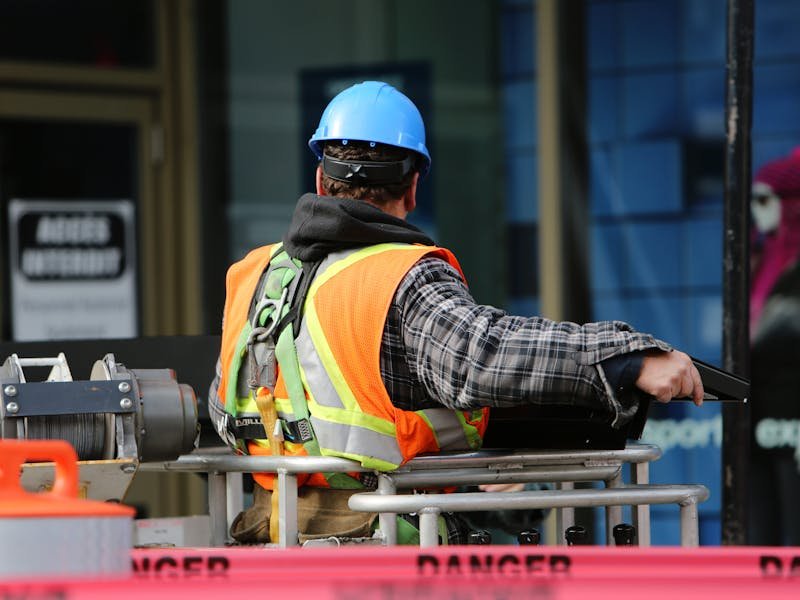
We are not trying to use scare tactics here. We are using real data, because the numbers tell a story that every homeowner should hear before they fire up a chainsaw or lean a ladder against a tree.
According to the Tree Care Industry Association and data from the U.S. Bureau of Labor Statistics, tree work is consistently ranked among the most hazardous occupations in America. On average, more than 100 people are killed annually in tree-related work accidents, and thousands more suffer serious injuries. That figure includes trained professionals. For untrained homeowners, who account for a significant portion of these incidents, the risk is even higher per exposure hour.
The U.S. Consumer Product Safety Commission reports approximately 36,000 chainsaw-related injuries requiring emergency room treatment each year. Many of these are homeowners attempting DIY tree work. The most common chainsaw injuries are to the legs and knees (from kickback or losing control of the saw), hands and arms, and the head and face.
Falls are the other major category. The CDC reports that falls are the leading cause of nonfatal injuries treated in emergency departments, and tree-related falls are a significant subset. Every spring in Huntsville, local emergency rooms see a spike in fall injuries as homeowners head outside to deal with storm damage and overgrown trees after winter.
Here is a statistic that really puts it in perspective: the average emergency room visit in Alabama costs between $2,500 and $5,000 for a straightforward injury. A serious injury requiring hospitalization, surgery, and rehabilitation can easily run $50,000 to $200,000 or more. The average cost of professional tree service that would have prevented the accident? A few hundred to a couple thousand dollars. The math could not be more clear.
The Equipment Gap: What Professionals Have That You Don't
One of the reasons DIY tree work is so dangerous is the equipment gap. Professional tree service companies invest hundreds of thousands of dollars in specialized equipment designed specifically for safe, efficient tree work. Here is a partial inventory of what our crews bring to a typical job that no homeowner has in their garage:
Aerial lifts and bucket trucks. When we need to reach the upper canopy of a large tree, we use a bucket truck with a hydraulic boom that can reach 75 feet or more. The bucket provides a stable, enclosed platform to work from, with controls at your fingertips. Compare that to a homeowner on a wobbly ladder leaned against a branch.
Professional climbing gear. When a bucket truck cannot reach or access a tree, our climbers use specialized saddles, ropes, carabiners, friction devices, and flip lines that allow them to move safely through a tree canopy while keeping them tied in at all times. A fall from height means swinging on a rope, not hitting the ground. This gear costs thousands of dollars per climber and requires extensive training to use safely.
Rigging systems. Lowering heavy sections of a tree in a controlled manner requires block-and-tackle rigging, high-strength ropes, pulleys, and anchor points strategically placed in the tree. Our crew members are trained in rigging dynamics, load calculations, and mechanical advantage systems. This is not something you can learn from a video.
Commercial-grade chainsaws with safety features. Professional tree saws are built differently from the consumer models you find at the home improvement store. They have more powerful chain brakes, reduced kickback bars, and better power-to-weight ratios for one-handed operation at height. Our arborists also maintain their saws meticulously, because a sharp, properly tuned saw is a safer saw.
Chippers and stump grinders. Processing the debris from tree work requires industrial equipment. A professional chipper can process 12-inch diameter branches in seconds. A commercial stump grinder can remove a 24-inch stump in under an hour. Attempting this work with hand tools or consumer-grade equipment is exponentially slower and more dangerous.
The Insurance Issue: Why This Matters More Than You Think
Beyond personal safety, there is a liability dimension to DIY tree work that many homeowners do not consider until it is too late.
If You Hurt Yourself
Your health insurance will cover your medical bills, assuming you have coverage. But you are still on the hook for deductibles, copays, and any costs that exceed your coverage limits. If the injury is severe enough to keep you out of work, you are also losing income. There is no workers' compensation for a homeowner who gets hurt doing their own tree work.
If You Damage Your Own Property
If you drop a tree on your own house, your homeowner's insurance may cover the structural damage, but it depends on the specifics of your policy. Some policies exclude damage caused by the homeowner's intentional actions (like felling a tree). Even if covered, you will likely pay your deductible and your premiums will increase. And the damage to the tree itself? That is never covered, because you did it on purpose.
If You Damage Your Neighbor's Property
This is where it gets really expensive. If your DIY tree removal goes wrong and the tree lands on your neighbor's house, car, fence, or pool, you are personally liable for all damages. Your homeowner's insurance may cover this under your personal liability provision, but if the insurance company determines you were negligent (which an untrained person doing tree work arguably is), they may deny the claim. In Alabama, property damage lawsuits can result in judgments well into six figures.
We have seen this exact situation play out in Decatur and Athens, where homeowners attempted to fell trees near property lines and the trees went the wrong direction. One case we know of in a neighborhood off Highway 72 resulted in a tree going through the neighbor's garage. The homeowner who felled it ended up paying over $35,000 out of pocket because his insurance denied the claim based on negligence.
If Someone Else Gets Hurt on Your Property
Maybe you do not plan to do the work yourself. Maybe your buddy from work says he used to do tree work and he will take care of it for you for a case of beer. Or maybe you find a guy on Facebook who will do the job for cash, no contract, no insurance. What could go wrong?
If that person gets injured on your property, you are potentially liable. Alabama premises liability law means that property owners have a duty to ensure the safety of people on their property. If an uninsured worker is injured while performing tree work on your property, their medical bills, lost wages, and pain and suffering could become your financial responsibility. We go deeper into the insurance considerations when hiring tree service in a separate article, and we strongly recommend reading it.
When "Saving Money" Actually Costs More
Let's run the numbers on a real-world example that we see all the time in Huntsville. A homeowner has a 50-foot loblolly pine that needs to come down. It is in the backyard, about 20 feet from the house, with some lean toward the structure.
Professional removal cost: Typically $800 to $1,500 for this type of job, including felling, limbing, chipping, and cleanup. Add stump grinding for another $150 to $250.
DIY attempt costs (assuming nothing goes wrong): Chainsaw rental or purchase ($50-$400), fuel and bar oil ($20), personal protective equipment if purchased ($100-$200), truck load to the dump or disposal fees ($50-$100). Total: $220 to $720, plus an entire day or more of extremely hard, dangerous labor.
DIY attempt costs (when something goes wrong): Emergency room visit for chainsaw injury ($3,000-$10,000), ambulance ride ($1,000-$2,500), surgery if needed ($20,000-$100,000), lost wages during recovery ($2,000-$20,000+), tree falls on house and causes structural damage ($15,000-$75,000+), increased insurance premiums for years. Total potential exposure: tens of thousands to hundreds of thousands of dollars.
Even in the best-case scenario where nothing goes wrong, the DIY savings on a job like this are maybe $500 to $800. Is that worth the risk to your life, your health, your property, and your financial security? We do not think so. And we have this conversation with homeowners across Research Park, Bailey Cove, and the greater Huntsville area every week.
How to Find a Reputable Professional Tree Service in Huntsville

So you have decided to hire a professional. Smart move. But not all tree services are created equal, and in the Huntsville market, as in any growing metro area, there are operators out there who are barely a step above a homeowner with a chainsaw. Here is how to find a legitimate company.
Verify insurance. Any tree service you consider should carry general liability insurance (at least $1 million) and workers' compensation coverage for their employees. Ask for certificates and call the insurance company directly to verify the policies are current. A certificate of insurance that someone hands you is only as valid as the policy behind it, and policies can be canceled the day after the certificate is issued. We cover this topic extensively in our article on tree service insurance.
Look for ISA certification. The International Society of Arboriculture (ISA) certifies arborists through a rigorous testing process. An ISA Certified Arborist has demonstrated knowledge of tree biology, diagnosis, maintenance practices, and safety procedures. Not every good tree worker has the certification, but it is a meaningful credential that shows a commitment to professional standards.
Get multiple estimates. For any significant job, get at least three written estimates. This gives you a sense of the fair market price and helps you identify outliers, both suspiciously cheap and unreasonably expensive. If one estimate is dramatically lower than the others, that is a red flag, not a deal. It usually means the company is cutting corners on insurance, equipment, or crew quality.
Check references and reviews. Look at Google reviews, ask for references from recent jobs in your area, and check with the Better Business Bureau. A company that has been serving the Huntsville area for years with consistently good reviews is a much safer bet than a newcomer with a truck and a chainsaw.
Never pay the full amount upfront. A reputable tree service will not ask for full payment before the work begins. A small deposit for large jobs is reasonable. Full payment upon completion is standard. If someone wants all the money before they start, walk away.
Frequently Asked Questions
What tree work can I safely do myself?
Homeowners can safely handle small branch pruning on branches under 2 inches in diameter that can be reached from the ground with a pole pruner, mulching around trees, visual inspection for obvious problems like dead branches or fungal growth, watering during drought periods, and cleaning up fallen branches and debris after storms. The key safety rule is simple: if the job requires a ladder, a chainsaw, or getting within 10 feet of a power line, it should be left to professionals.
How dangerous is DIY tree removal?
Extremely dangerous by any measure. Tree work is consistently ranked among the most hazardous occupations in the country. More than 100 people are killed annually in tree-related accidents, and tens of thousands are seriously injured. Homeowners are at significantly higher risk than trained professionals because they lack proper equipment, safety training, and experience. The most common injuries are chainsaw lacerations, falls from height, and being struck by falling branches. Many of these injuries result in permanent disability.
How much does professional tree service cost in Huntsville?
Professional tree trimming in the Huntsville area typically runs $200 to $800 depending on the tree's size, species, and the scope of work needed. Tree removal ranges from $300 to $2,500 or more for very large trees or complex removals near structures. Stump grinding costs $100 to $400 per stump. While these prices are not trivial, they represent a tiny fraction of the potential cost of an emergency room visit, property damage from a failed DIY attempt, or a liability lawsuit.
What happens if an uninsured person gets hurt doing tree work on my property?
This is a serious liability exposure that many homeowners do not think about. If you hire an uninsured worker, or a friend volunteers to help with tree work and they are injured on your property, you could be held financially responsible for their medical bills, lost wages, rehabilitation costs, and pain and suffering. Your homeowner's insurance may provide some coverage, but many policies have exclusions or limitations for injuries related to tree work performed by unlicensed or uninsured individuals. The potential financial exposure in Alabama can be substantial.
Should I use a chainsaw to cut tree branches myself?
Unless you have formal training in chainsaw operation and use proper personal protective equipment, including Kevlar chaps, a full-face helmet, hearing protection, and cut-resistant gloves, we strongly advise against it. Chainsaws account for approximately 36,000 emergency room visits annually in the United States. Kickback, which happens in milliseconds, can direct the spinning chain toward your face and upper body faster than you can react. If you need to use a chainsaw for ground-level work like cutting firewood, invest in a safety course and the full complement of protective gear first.
Why does professional tree removal cost so much?
Professional tree service pricing reflects enormous overhead costs that ensure your safety and protect you from liability. A single bucket truck costs $100,000 or more. A commercial chipper runs $30,000 to $80,000. Workers' compensation insurance for tree workers is among the most expensive of any industry because of the hazard level. General liability insurance, crew training and certification, equipment maintenance, fuel, and disposal costs all add up. When you hire a reputable tree service, you are paying for safety, expertise, proper equipment, and the insurance that protects you if anything goes wrong.